EG254S: IoT System Project
|
IoT Network
 The Mesh Network The Mesh NetworkMesh Networks and IoT
In the past, building beyond a single-point of connection required high-cost
hardware solutions and software implementations to connect the in-between spaces
needed for device-to-device communication. As IoT platforms have matured,
they have started to embrace a low-power, low-cost alternative that can bridge
the gaps between these devices: wireless mesh networks.
What is a Wireless Mesh Network?
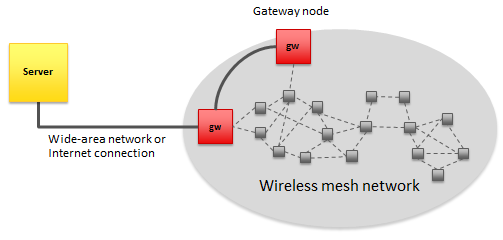
A wireless mesh network is an infrastructure of nodes (a mesh topology)
that are wirelessly connected to each other. These nodes piggyback off each other
to extend a radio signal (like a Wi-Fi, Bluetooth, ZigBee, Sigfox,
LoRaWAN or even 2G/3G/4G cellular connection) to route, relay, and
proxy traffic to/from clients. Each node spreads the radio signal a little further
than the last, minimizing the possibility of dead zones.
|
|
What are the Components of a Mesh Network?1. Gateway — Border routers are the devices that have additional connectivities beyond mesh that allow them to pass messages between networks. You can think of these devices as providing a “backhaul” to the internet for the local mesh network. 2. Repeater — Routers are devices that forward messages between end devices (endpoints) in a mesh network. They are not typically designed to sleep because they are a part of the mesh networks’ infrastructure. 3. Endpoint — End devices are mesh-only devices that do not route messages for other devices in the mesh network. Because they have no networking responsibilities, they can enter sleep mode and are good candidates for battery-powered nodes and sensors. |
The Cellular Network Topology - Rat Bait Stations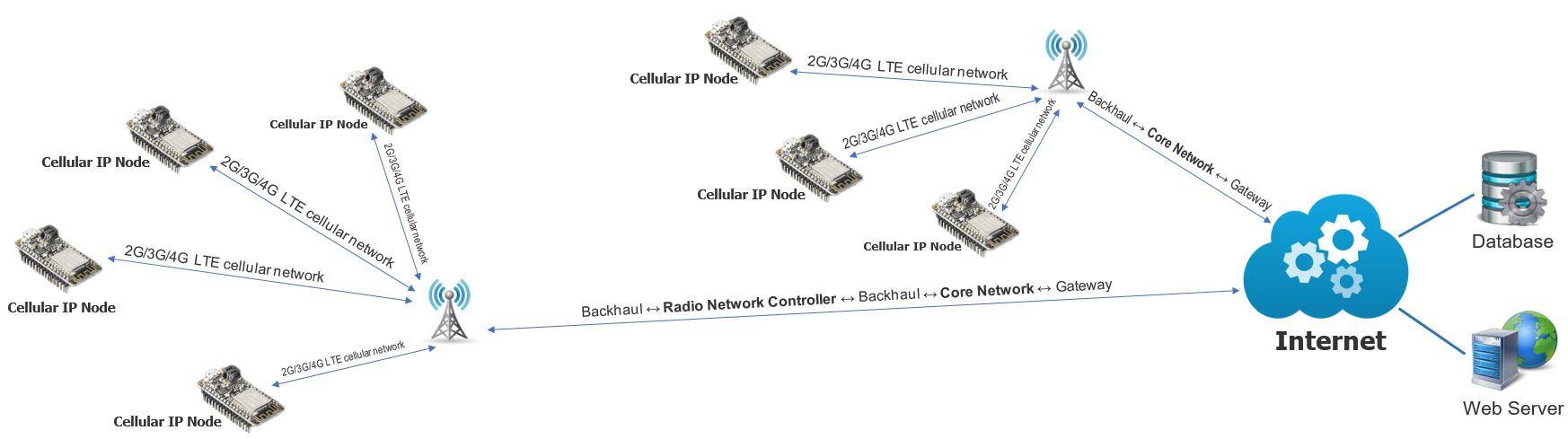
|
|
Currently, pest control companies use Rat Bait Stations integrated with cellular IP module
to send data or alerts when there's a rat activity. This requires high running cost as well as
higher cost for future scalability of the business. Although the advantages of mobility for the
Rat Bait Stations, the high cost outweighs the benefits.
|
THE SOLUTION:The Wireless Mesh Network Topology - Rat Bait Stations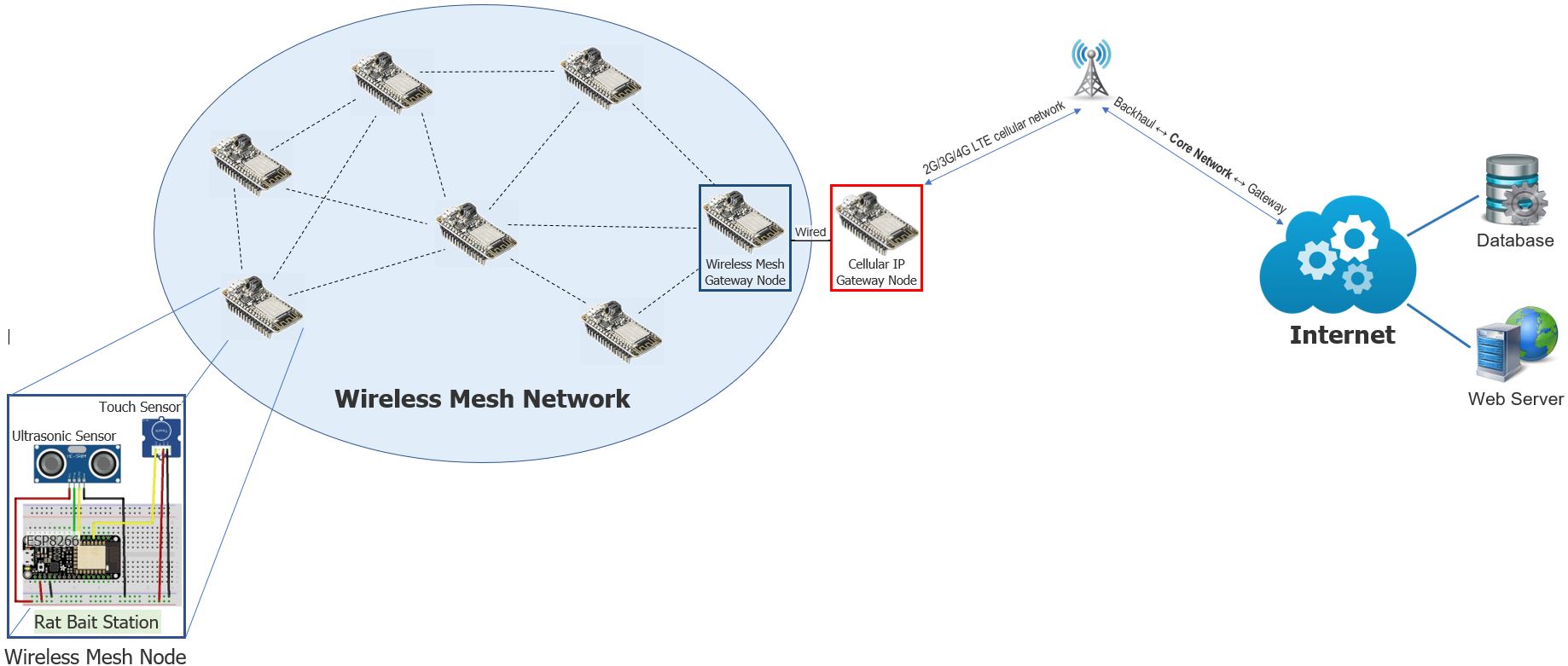
|
|
How does Mesh Networking and IoT Work Together?
It should be noted that each mesh networking solution works differently. In my project
development of a collaborative Rat Bait Station using Mesh Network, I have chosen
the ESP8266 as the microcontroller using the integrated WiFi to build a
wireless mesh network.
Traditional
IoT devices that use WiFi and cellular connectivity depend on the cloud to
relay messages between devices. This works great when you’re making a
standalone product — but sometimes you need more than that.
IoT
devices typically perform machine-to-machine (M2M) communication over
lightweight connectivity protocols like XMPP (an XML-based chat
protocol), CoAP (Constrained Application Protocol), or MQTT (MQ
Telemetry Transport).
Hence,
I have chosen the MQTT protocol for IoT device management. From my web search
on using ESP8266 for mesh network, the
meshquitto (https://github.com/sglvladi/meshquitto),
has come up as the best choice. It is a simple Arduino project, which aims to
provide a gateway between a mesh network of ESP8266's and a remote MQTT broker.
|
The Meshquitto Network Topology - Rat Bait Stations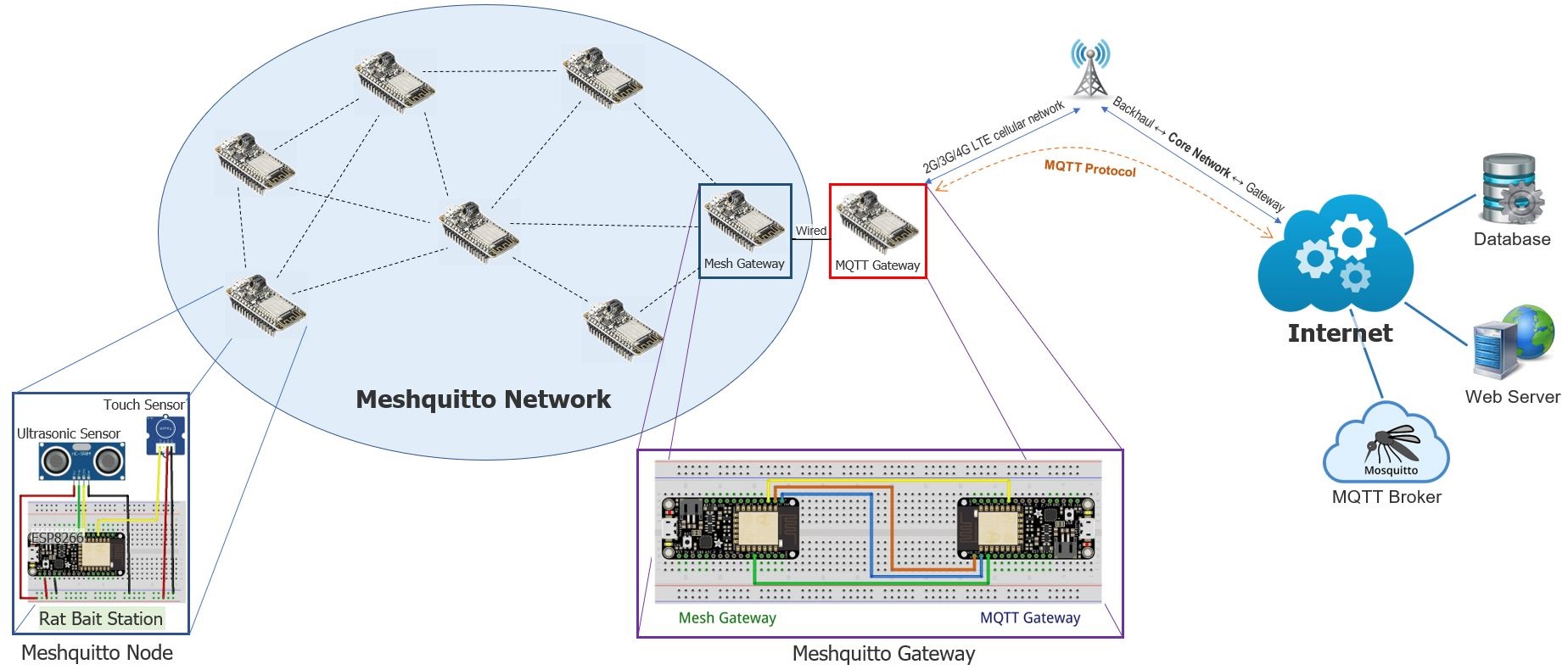
|
|
The following are the steps for setting up the Meshquitto network.
|
Why use Mesh Networking for IoT?
While wireless mesh networking technologies has been around for some time,
only recently has the power of mesh reached a point of maturity alongside
high availability from chip and silicon vendors. With newer approachable costs,
wireless mesh networking has become ideal for IoT builders. And with the rise of
connected homes and industry support on open source resources, Mesh
is now truly accessible while being low-cost enough to scale for production. As such,
wireless mesh networking is becoming a much more viable, real choice for industrial
and commercial IoT applications. It can provide additional services in a system where
extending a connection between two nodes is limited:
1. Smart Cities — Wireless mesh networking is great for extending radio signals through parking garages, campus grounds, business parks, and other outdoor facilities. Parking garages that utilize space availability checkers benefit greatly from mesh networks because they can extend the signal throughout the whole space, and be able to communicate when a spot has been taken by other clients. 2. Smart Home — Wireless mesh networks can help you track and manage temperatures across your house. Setup one powered gateway and use temperature sensors and Mesh-enabled nodes in each room to capture live data and adjust settings automatically. 3. Healthcare Equipment — Wireless mesh networks can help monitor and locate medical devices quickly. They can also act as a backup for medical equipment that always needs to remain online. If one node loses connectivity, another node can step in to keep the connection alive. 4. Farming — Wireless mesh networking is also great for tracking sun exposure and water levels across your crops. You can scale at a low cost with Mesh-enabled nodes across a whole acreage to create a cellular-connected IoT farm. |